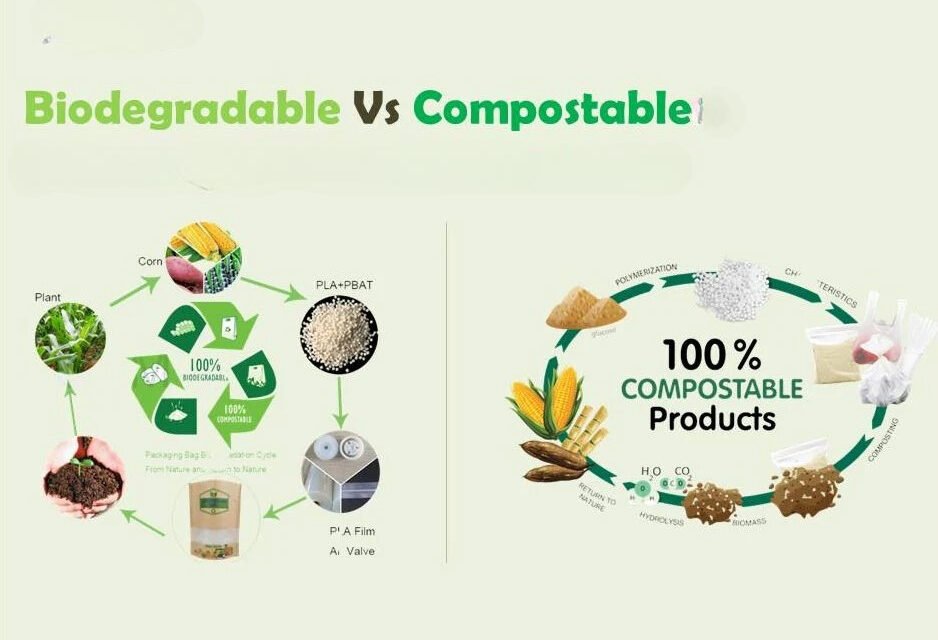
The terms biodegradable plastics and compostable plastics are often used interchangeably, but they refer to distinct types of materials with different properties, decomposition processes, and end results. Here’s a breakdown of the key differences:
1. Definition
Biodegradable Plastics
- Definition:
- Plastics that can break down into natural elements like water, carbon dioxide (CO₂), and biomass through the action of microorganisms (e.g., bacteria or fungi).
- Key Feature:
- Biodegradability depends on environmental conditions such as temperature, moisture, and microbial activity, and the time required can vary widely.
- Examples:
- Polyhydroxyalkanoates (PHA), polylactic acid (PLA under certain conditions), and some petroleum-based plastics engineered for biodegradation.
Compostable Plastics
- Definition:
- A subset of biodegradable plastics specifically designed to break down into water, CO₂, and non-toxic biomass within a specific timeframe and under defined composting conditions.
- Key Feature:
- Must leave no toxic residues and comply with standards for compostability (e.g., ASTM D6400, EN 13432).
- Examples:
- Polylactic acid (PLA), polybutylene adipate terephthalate (PBAT), and starch-based plastics.
2. Decomposition Conditions
Biodegradable Plastics
- Conditions:
- Can degrade in various environments, such as soil, water, or landfill, but require specific conditions like the presence of certain microorganisms.
- Timeframe:
- Degradation time can range from weeks to several years depending on the material and environment.
- Key Limitation:
- Biodegradation may not be complete, and some materials may leave microplastics or residues.
Compostable Plastics
- Conditions:
- Require controlled environments such as industrial composting facilities with specific temperatures (usually above 50°C), humidity, and microbial activity.
- Timeframe:
- Typically decomposes within 90-180 days in industrial composting conditions.
- Key Feature:
- Leaves behind nutrient-rich compost without toxic residues.
3. Standards and Certification
Biodegradable Plastics
- Standards:
- No universal standard for biodegradability.
- May be evaluated using tests such as ISO 14855 or ASTM D5988, which assess degradation in specific environments.
- Certification:
- Biodegradability claims vary widely and are less regulated than compostability.
Compostable Plastics
- Standards:
- Must meet stringent international standards:
- EN 13432 (Europe): Requires disintegration within 12 weeks and biodegradation within 6 months.
- ASTM D6400 (USA): Defines specifications for plastics compostable in industrial facilities.
- Testing includes assessments for toxicity, biodegradation rate, and residue.
- Must meet stringent international standards:
- Certification:
- Certified by labels such as OK Compost (TÜV Austria), Compostable (BPI), or Seedling Logo (European Bioplastics).
4. Environmental Impact
Biodegradable Plastics
- Benefits:
- Can decompose in various environments, reducing pollution if managed properly.
- Suitable for applications like agricultural mulch or single-use items.
- Concerns:
- May degrade into microplastics or take years to fully decompose in environments like landfills.
- Lack of infrastructure for proper disposal can limit effectiveness.
Compostable Plastics
- Benefits:
- Designed to return to the environment as non-toxic compost, supporting soil health.
- Ensures complete breakdown in suitable conditions without leaving microplastics.
- Concerns:
- Limited availability of industrial composting facilities.
- Compostable plastics that end up in landfills or oceans may not decompose effectively.
5. Use Cases
Biodegradable Plastics
- Applications:
- Agricultural mulch films.
- Disposable packaging in remote or natural environments.
- Fishing nets designed to biodegrade in marine settings.
- Best For:
- Applications where controlled composting is not feasible, but biodegradation in the environment is beneficial.
Compostable Plastics
- Applications:
- Food packaging and utensils.
- Compostable bags for organic waste collection.
- Medical applications like sutures.
- Best For:
- Products intended for disposal in industrial composting systems.
6. Challenges
Biodegradable Plastics
- Misuse and Mislabeling:
- Ambiguous claims can mislead consumers, resulting in improper disposal.
- Environmental Dependency:
- May not degrade effectively in anaerobic conditions (e.g., landfills).
- Microplastics:
- Partial degradation can lead to pollution from microplastics.
Compostable Plastics
- Infrastructure:
- Limited access to industrial composting facilities in many regions.
- Consumer Confusion:
- Misidentification with biodegradable plastics can lead to improper disposal.
- Cost:
- Typically more expensive than conventional or biodegradable plastics.
Both materials contribute to reducing environmental impact, but their effectiveness depends on disposal systems, application suitability, and consumer awareness. Understanding the distinctions ensures their proper use and disposal, maximizing environmental benefits.