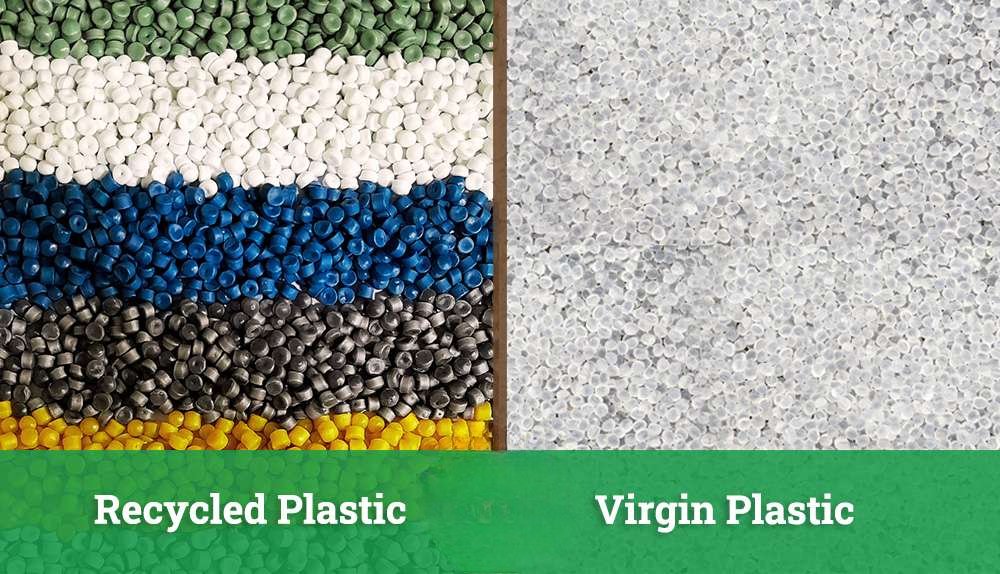
Virgin plastic and recycled plastic raw materials differ in their source, properties, applications, and environmental impact. Here’s a detailed comparison:
1. Source and Production
- Virgin Plastic:
- Made from new petrochemical feedstocks, typically derived from crude oil or natural gas.
- Produced through polymerization or polycondensation processes to form specific polymers like polyethylene (PE), polypropylene (PP), or polyvinyl chloride (PVC).
- Recycled Plastic:
- Derived from post-consumer or post-industrial waste, such as discarded packaging, bottles, or manufacturing scraps.
- Processed through mechanical (shredding, washing, remelting) or chemical recycling (depolymerization into monomers).
2. Material Properties
- Virgin Plastic:
- Quality: Uniform and consistent properties, such as strength, clarity, and flexibility.
- Durability: Typically stronger and more reliable due to the absence of contaminants or prior use degradation.
- Appearance: Clearer and more aesthetically appealing compared to recycled plastic.
- Versatility: Suitable for high-performance applications requiring precise mechanical and chemical properties.
- Recycled Plastic:
- Quality: Properties can vary based on the type of plastic, contamination levels, and the recycling process used.
- Durability: May have reduced mechanical strength or thermal stability due to degradation during previous use and recycling.
- Appearance: Often less clear or uniform in color; pigments or additives may be needed to improve aesthetics.
- Performance: May be blended with virgin plastic to achieve desired properties for demanding applications.
3. Cost
- Virgin Plastic:
- Generally more expensive due to the cost of raw petrochemical materials and energy-intensive production processes.
- Prices are influenced by crude oil and natural gas markets.
- Recycled Plastic:
- Typically cheaper, especially in regions with well-established recycling infrastructure.
- Costs can increase if extensive sorting, cleaning, or quality enhancement processes are required.
4. Environmental Impact
- Virgin Plastic:
- Carbon Footprint: High, due to the extraction of fossil fuels and energy-intensive production.
- Waste Generation: Contributes to plastic waste if not disposed of responsibly.
- Sustainability: Non-renewable, contributing to environmental degradation.
- Recycled Plastic:
- Carbon Footprint: Significantly lower, as recycling reduces the need for new raw materials and conserves energy.
- Waste Reduction: Diverts plastic waste from landfills and oceans, promoting circular economy principles.
- Sustainability: Supports sustainability goals by extending the lifecycle of plastic materials.
5. Applications
- Virgin Plastic:
- Preferred for applications requiring high strength, clarity, and purity, such as:
- Food and beverage packaging.
- Medical and pharmaceutical products.
- High-performance automotive or aerospace components.
- Preferred for applications requiring high strength, clarity, and purity, such as:
- Recycled Plastic:
- Suitable for applications where minor quality variations are acceptable, such as:
- Non-food packaging (e.g., detergent bottles).
- Construction materials (e.g., pipes, decking, and insulation).
- Textiles (e.g., recycled polyester from PET bottles).
- Suitable for applications where minor quality variations are acceptable, such as:
6. Regulatory Compliance
- Virgin Plastic:
- Easier to certify for food-grade and medical applications due to its purity and consistent properties.
- Recycled Plastic:
- Must meet stringent regulatory standards for specific applications, especially for food contact or medical use.
- Processes like FDA or EFSA certification may be required to ensure safety.
7. Blending and Compatibility
- Virgin Plastic:
- Used as a baseline material for consistency and performance in blends.
- Recycled Plastic:
- Often blended with virgin plastic to enhance mechanical properties and quality while maintaining cost efficiency.
8. Lifecycle
- Virgin Plastic:
- Starts a new lifecycle when produced, often contributing to a linear economy unless recycled.
- Recycled Plastic:
- Extends the lifecycle of existing materials, aligning with circular economy principles.
9. Challenges
- Virgin Plastic:
- Environmental concerns and increasing regulatory restrictions on single-use plastics.
- Rising costs due to fluctuating crude oil prices and carbon taxes.
- Recycled Plastic:
- Quality inconsistency due to contamination or mixed waste streams.
- Limited availability of high-quality recycled materials for certain applications.
- Technical challenges in maintaining properties during multiple recycling cycles.
Virgin plastic offers superior consistency and durability, making it essential for critical and high-performance applications. In contrast, recycled plastic is a more sustainable and cost-effective option for less demanding applications, aligning with growing environmental priorities. Blending the two often provides a balance between performance and sustainability.