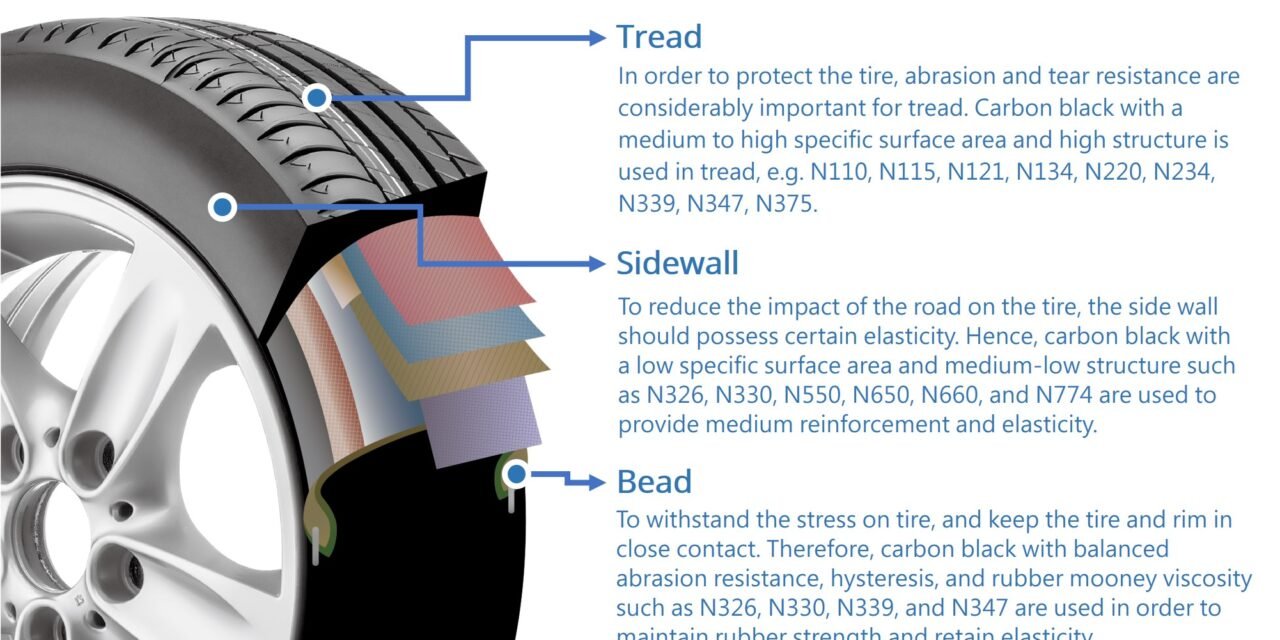
Carbon black plays a critical role in tire manufacturing, serving as an essential additive in the rubber compound that significantly enhances tire performance and durability. It is a fine, black powder made from the partial combustion of hydrocarbons and is used extensively in the production of synthetic and natural rubber for tires. Here’s how carbon black contributes to tire performance and durability:
1. Improved Durability and Wear Resistance
- Tire Tread Wear: One of the primary functions of carbon black in tire manufacturing is to increase the wear resistance of the tire tread. Carbon black reinforces the rubber, making it more durable and able to withstand the wear and tear caused by abrasion as the tire makes contact with the road. This helps extend the tread life of the tire, ensuring it lasts longer and performs well under regular driving conditions.
- Protection Against Abrasion: Carbon black enhances the abrasion resistance of the rubber, particularly in high-performance and commercial vehicle tires that experience heavy wear. It reduces the rate of tire degradation under constant friction, contributing to longer tire life.
2. Enhanced Strength and Toughness
- Reinforcement: Carbon black acts as a reinforcing agent in the rubber compound. It strengthens the tire by improving the rubber’s elasticity and tensile strength. This reinforcement ensures that the tire maintains its shape and structure under stress, such as during high-speed driving, cornering, or heavy loads.
- Puncture Resistance: The inclusion of carbon black improves the toughness of the tire, which makes it more resistant to punctures or damage from sharp objects on the road.
3. Improved Traction and Grip
- Road Grip: Carbon black enhances the frictional properties of the rubber, improving the tire’s traction on both dry and wet surfaces. It increases the surface contact between the tire and the road, resulting in better grip and handling, which is crucial for safety, especially during acceleration, braking, and cornering.
- Wet Traction: In addition to providing better traction on dry roads, carbon black also improves wet traction by enhancing the tire’s ability to displace water, reducing the likelihood of hydroplaning and maintaining better control in rainy conditions.
4. UV and Ozone Protection
- Protection from Environmental Factors: Carbon black also acts as a protective agent against the harmful effects of ultraviolet (UV) light and ozone. These environmental factors can cause rubber to crack, harden, or degrade over time. By absorbing UV light, carbon black prevents the breakdown of the rubber and helps maintain its flexibility and durability, ensuring the tire’s longevity.
- Resistance to Cracking: The ozone resistance provided by carbon black helps prevent ozone cracking, which can otherwise lead to tire failure. This is particularly important for tires that are exposed to harsh outdoor conditions over long periods.
5. Improved Heat Dissipation
- Heat Resistance: Carbon black also contributes to the tire’s heat resistance. As tires heat up during use due to friction and pressure, carbon black helps the rubber dissipate heat more efficiently. By reducing heat buildup, carbon black helps maintain the structural integrity of the tire and prevents premature aging or tire blowouts.
- Reduced Rolling Resistance: The thermal conductivity of carbon black ensures that tires operate at optimal temperatures, contributing to better fuel efficiency by minimizing rolling resistance. Tires with lower rolling resistance require less energy to move, which reduces fuel consumption in vehicles.
6. Black Color and Aesthetic Appeal
- Aesthetic Role: The most obvious and traditional role of carbon black in tires is to give them their characteristic black color. While this doesn’t affect performance directly, the aesthetic appearance of a black tire is a standard in the industry, and it also helps to mask dirt and wear marks, contributing to the overall appearance of the tire.
Carbon black is a key material in tire manufacturing, playing a crucial role in improving tire durability, performance, and safety. It contributes to wear resistance, traction, strength, and heat dissipation, while also protecting against environmental factors such as UV rays and ozone. By enhancing the overall performance and longevity of tires, carbon black ensures that they perform optimally throughout their lifespan, providing safety, efficiency, and cost-effectiveness for both consumers and manufacturers.